An Estimate Is More Than a Number. It Is a Business Decision.
Two contractors can reach different defensible prices because the number reflects the business behind the bid. The harder part is preserving why it changed, who approved it, and the exact document that was sent to the customer.

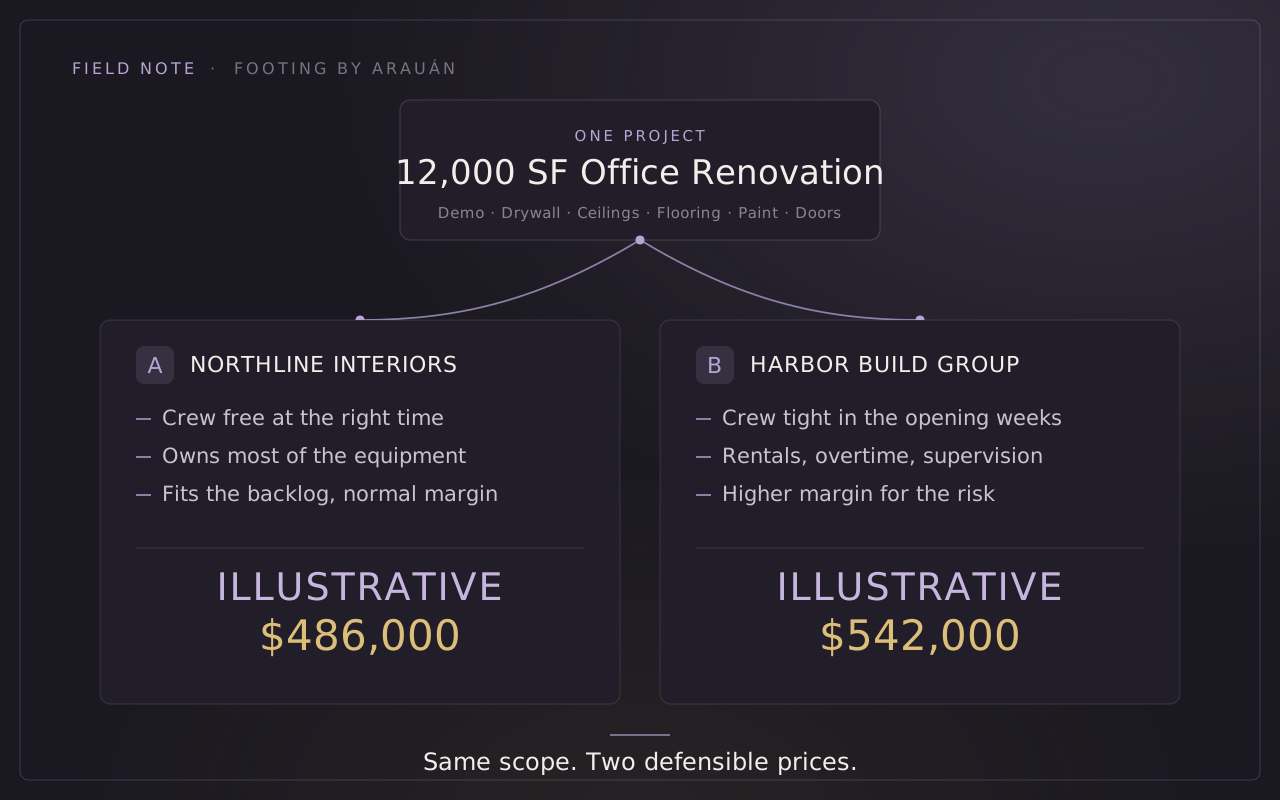
An estimate may end with a number, but that number reflects the business behind the bid: the crew, the relationships, the risks, and the lessons of the company standing behind it.
An estimate may end with a number, but that number is not where it begins. It begins with how a contractor understands the work, and it is shaped by everything the documents leave out: the crew you can put on it, the suppliers you trust, the equipment already sitting in your yard, the risks you have learned to price for, and the kind of business you are trying to build.
An estimate carries more than quantities and rates. It carries experience. The projects that went well and the ones that went sideways. The supplier who came through when it mattered. The customer who asked for five revisions. The crew that always finishes early, and the one line of scope that looked harmless until it started costing money.
That is why two contractors can read the same project, understand the scope correctly, and still arrive at two different prices that are both defensible. Their numbers reflect two different businesses making two different decisions.
The same project, two defensible estimates
Consider an illustrative renovation. A local organization is redoing a 12,000-square-foot office building: demolition, drywall, acoustic ceilings, flooring, paint, and the replacement of several interior doors. Nothing exotic.
The catch is in the conditions. Part of the building stays occupied throughout, so the work has to run in phases, some of it after hours, with the schedule locked and the customer kept in the loop the whole way. Two contractors receive the same drawings, the same specifications, the same addenda. They are looking at the same building and pricing the same scope. They still land on different numbers.
The same scope, priced by two different businesses.
A 12,000 square foot office renovation. The building stays partly occupied, some work runs after hours, and the schedule needs careful phasing and customer coordination.
- A crew available at the right time
- Owns most of the equipment already
- Supplier pricing from an established relationship
- Familiar with occupied-building work
- Fits the backlog, at a normal margin
The work fits how Northline already operates.
- A constrained crew schedule
- Added supervision and possible overtime
- Equipment rental required
- More contingency after a hard past job
- A higher margin for a demanding schedule
Priced for what delivery will realistically require.
Both numbers are defensible. Each reflects the business behind the bid, not just the project documents.
Northline Interiors
Northline Interiors prices it at an illustrative $486,000.
Their timing is good. An experienced interiors crew is coming off another job in two weeks, so Northline can move it straight onto this site with no one left standing around. They already own most of what the work needs, lifts, dust-control equipment, temporary barriers, so there is little to rent. And they have a long-standing relationship with a regional drywall and ceiling supplier who gives them favorable pricing and dependable delivery, because Northline sends steady volume its way.
They have also done several occupied-building renovations before. The crew knows the daily rhythm of setup, cleanup, and communication that working around other people demands, so Northline can plan the phasing with confidence.
Their number reflects a business the job happens to fit:
- —A crew free at exactly the right time
- —Equipment they already own
- —Supplier pricing earned through a real relationship
- —Genuine experience with occupied-building work
- —A project that slots into the current backlog
- —A normal margin, because the work matches how they already operate
Northline is not pricing low because it missed the complexity. It is pricing on advantages that are genuinely real for its business.
Harbor Build Group
Harbor Build Group prices the very same scope at an illustrative $542,000.
Harbor reads the drawings just as well, and it is fully capable of the work. Its conditions are simply different. Its primary interior crew is committed elsewhere for the first three weeks of the schedule, so hitting the customer's deadline may mean overtime, an extra supervisor, or a subcontracted crew for part of the job. It does not own everything the work calls for either, so two lifts and additional dust-control equipment have to be rented.
There is history in Harbor's number too. A previous occupied renovation went hard: access windows kept changing, approvals came in late, and the crew lost productive hours waiting for rooms to open up. That job taught Harbor to price coordination and phasing risk deliberately, so this estimate carries more supervision, a stronger after-hours allowance, and more contingency for disruption. Its flooring supplier has also flagged a possible lead-time problem on one specified product, and Harbor has built in the cost of protecting the schedule if it has to source an alternative fast.
Their number reflects a business that has to solve for more:
- —A crew that is tight in the opening weeks
- —Added supervision and possible overtime
- —Equipment that has to be rented
- —Extra caution earned on a hard past project
- —Possible material lead-time risk
- —More contingency for phasing and access
- —A higher minimum margin for a demanding schedule
Harbor is not padding the bid. It is pricing what delivering this job successfully would actually take, for Harbor.
Both numbers can be defensible
Northline is lower because the project fits its capacity, its relationships, and the way it already runs. Harbor is higher because its schedule, its equipment position, and a lesson from a previous job add real cost and real risk. Both read the same documents. Both identified the same major scope. Both applied sound business reasoning.
The difference between their estimates does not come only from the project. It comes from the companies performing the project.
That distinction is the whole point. The documents can describe the work, but they cannot describe what the work means to each contractor. They do not know which crew is free, or which supplier picks up the phone when an order changes. They do not know what equipment is sitting in your yard, whether this job fills a gap in your schedule or stretches you too thin, or how much risk your business is built to carry.
Those are business facts, and they belong in the estimate.
Your price is rooted in how you do business
A contractor's price is shaped by far more than the going rate for labor and materials. It is rooted in things no plan set can see:
- —The productivity of a particular crew
- —The strength and reliability of supplier relationships
- —The inventory and equipment already on hand
- —Current workload and capacity
- —Travel and mobilization
- —Customer history
- —Payment risk
- —Schedule pressure
- —The likelihood of revisions
- —Lessons from previous projects
- —Company overhead
- —The margin that makes the job worth doing
- —The direction you want the business to go
Two companies can look at the same opportunity and see different things, because they are not standing in the same place. For one, the job is a natural fit; for another, it means real disruption. For one, it strengthens a key customer relationship; for another, it eats resources a more strategic job will need. For one, a standard margin is fine; for another, the added risk only makes sense at a higher price. A good estimate reflects those realities instead of pretending they are not there.
Your estimate should tell your story
An estimate should tell the story of how your business understands the work and intends to deliver it. It should reflect what your company has earned: what you do well, and what you have learned to watch carefully. It should show your scars.
Every hard project should leave something useful behind. A material delay teaches you where to build in lead-time protection. An unprofitable job shows you the cost you kept overlooking. A customer who wanted change after change reshapes how you price revisions and coordination. A crew that consistently beats the schedule lets you price the next job from evidence instead of a generic assumption. Those lessons should not vanish when the project closes. They should make the next estimate stronger.
There is no universal correct price
It is tempting to believe every project has one true price, and that better software will eventually find it. Construction does not work that way.
There is usually a reasonable market range, common labor rates, typical material prices, sensible production assumptions, and those signals are genuinely useful. But a market range is not the same as the right price for you. The market does not know your exact conditions: your crew, your equipment, your relationships, your workload, your history, your goals. A market signal is at its best when it tells you your number looks unusually high or unusually low and prompts you to check a trade, revisit a quantity, or challenge an assumption. That is valuable. It should guide the decision, not make it.
What AI can bring to the estimate
Used well, AI takes work off your plate that would otherwise burn hours. It can read the project documents, identify scope, surface the requirements that drive cost, flag missing information, and pull useful pricing signals into view. It is good at questions like these:
- —What work appears to be required?
- —Which requirements could affect cost?
- —What information is missing?
- —Which areas deserve a closer look?
- —How does this starting point compare with what else we know?
- —Which assumptions still need the contractor's confirmation?
It can give you structure, a starting point, and a clearer view of what is actually in front of you. What it should never do is present that starting point as the only correct answer.
A number built from broad market information cannot account for the specific reality of Northline or Harbor. The system does not inherently know that Northline owns its lifts, or that Harbor's crew is booked for the first three weeks. It does not know the history behind Harbor's phasing contingency, or that Northline's supplier relationship is a genuine pricing advantage, unless that experience has been captured and brought into the decision. That knowledge belongs to the contractor.
AI brings information. The contractor brings meaning.
So the role of AI is to surface what matters and help you see what might shape the estimate. You apply the context. You decide whether a market signal fits your business, whether a past job is truly comparable, whether a risk deserves more contingency, whether the project even serves where you are trying to go, and what price you can deliver, explain, and stand behind. That is not a weakness in the technology. It is the right relationship between the tool and the professional using it: AI does not need to replace your judgment to be valuable, it needs to make that judgment better informed.
- AI can help you move faster.
- AI can notice what you might have missed.
- AI can organize complex information.
But the final decision is yours.
A good estimating system should ask better questions
There is a tell that separates a helpful system from a merely confident one. When it hits uncertainty, it does not paper over the gap with an assumption. Sometimes the most useful thing it can do is ask:
- —Do you already own the equipment this work needs?
- —Is your crew available for the proposed schedule?
- —Do you have a supplier or subcontractor relationship for this trade?
- —Have you done a similar occupied-building project?
- —Did that job reveal risks worth carrying here?
- —Does this customer have a history of frequent revisions?
- —Is this the kind of work you actually want to pursue?
- —What margin would make this schedule worth the pressure?
Questions like those pull the contractor's knowledge into the estimate. They turn the work from automated calculation into a decision the contractor actually supports.
The number should be defensible
The best estimate is not the lowest number, or the one nearest a market average, or whatever an AI produced first. The best estimate is the one the contractor can understand, explain, deliver, and defend.
Northline should be able to say exactly why its number is $486,000. Harbor should be able to say exactly why its is $542,000. Each can point to the conditions, the experience, and the reasoning behind it. That reasoning earns its keep when you review the bid internally, when a customer asks why the price moved, when you win the job, and most of all when you lose it or it turns unprofitable. A number without its reasoning is almost impossible to learn from.
A number connected to its reasoning becomes business intelligence.
The number is only the beginning
An estimate can be thoughtful, defensible, and completely disconnected from what happens next.
One version is reviewed. An addendum creates another. Someone says “looks good” in an email without naming which file they mean. The proposal is prepared from a spreadsheet that may or may not contain the approved amount. A final Word or PDF document is edited before it leaves the company. Weeks later, everyone remembers that the bid was sent, but nobody can say with certainty which number was approved or which document was actually sent to the customer.
That is not an estimating problem. It is a decision-record problem.
If an estimate is a business decision, the reasoning cannot stop at the number. The exact estimate version, the person authorized to approve it, the proposal created from it, the final document sent to the customer, and any later revision should remain connected.
The exact estimate, kept connected to everything it became.
- 01EstimateEstimate v3 · $486,000
The exact version under review, with its reasoning attached.
- 02ApprovalApprovedApproved by Maya Chen
One named person, one amount, one date. September 14.
- 03ProposalProposal v1
Bound to Estimate v3, not to whatever the number becomes later.
- 04Final documentNorthline-Proposal-0914.pdf
The exact file that leaves the company, preserved as sent.
- 05Sent recordSent, and recorded as sent
The exact file that left, sent through the company's approved email connection and kept as its own record.
- 06RevisionRevisionA newer estimate arrives
Estimate v3, its approval, and Proposal v1 stay exactly as they were. The revision becomes a new decision, recorded beside the old one.
The approved amount never moves. A newer estimate is a new decision, recorded beside the one that came before it, not written over it.
A newer estimate is not automatically the approved estimate. A proposal is not governed merely because an approved number existed somewhere. And finding a PDF later is not the same as knowing it was the file that actually went out.
What Footing carries forward
Footing does not need to replace the estimating system you already trust.
Bring the bid and the estimate you are already using. Footing keeps the original source, the working versions, the questions that remain, and the exact version a named person approved. It keeps the proposal connected to that approval and preserves the final customer document and the record of how it went out.
When the bid changes, Footing does not rewrite history. The prior estimate, approval, proposal, and sent record remain true for the moment in which they happened. The revision becomes a new decision.
Because an estimate is more than a number. It is a business decision. And a business decision should not disappear into a folder, an inbox, or somebody's memory the moment the number moves.
Your estimate should tell your story. It should show your scars. And the record should show which version your company chose to stand behind.
Anita Njoku builds AI-native products that turn fragmented operational systems into trusted decision intelligence. Her work focuses on making uncertainty visible, preserving human judgment, and helping teams make better calls with the information they already have. Footing is her first product under ARAUÁN, built to help contractors find solid ground before the bid.
Want AI that shows its work?
Join early access to Footing.
Footing is opening with contractors who want source-backed estimates, clearer bid intelligence, and firmer footing before the proposal goes out — so every bid leaves you on better ground than the last.